Your Manual Die Handling Costs 40% More in Material Waste
Every time an operator picks up a blank with tongs and places it by hand, you lose material to poor nesting, time to slow cycle speeds (8–12 SPM), and money to the 4–5 operators standing at each press. Transfer dies eliminate all three problems — one operator monitors the HMI while the press runs at up to 40 strokes per minute with ±0.01 mm repeatability.
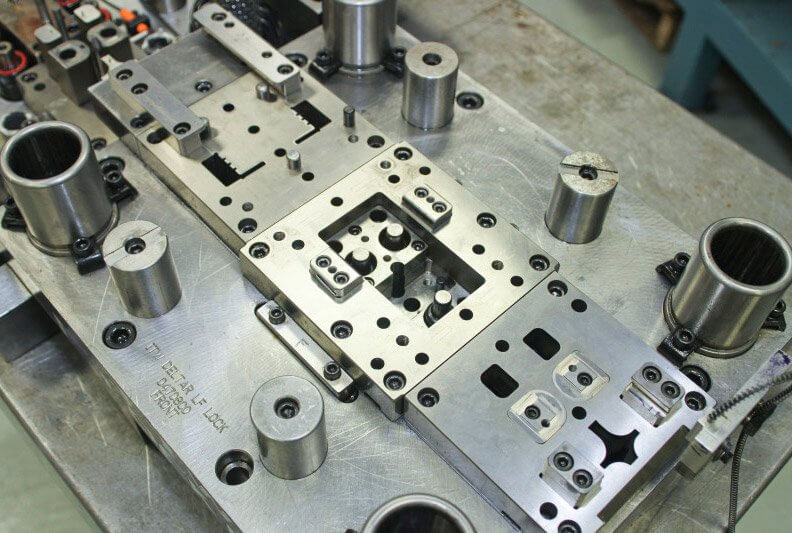
What Is a Transfer Die?
In a transfer die, individual blanks are cut from the sheet and moved independently between multiple stations inside a single press. Each station performs a different operation — piercing, bending, drawing, trimming. A servo transfer system (mechanical arms with grippers) picks each blank from one station and places it precisely into the next.
Unlike progressive dies where the strip stays connected throughout the process, transfer dies let you rotate, flip, and deeply draw parts that progressive tooling physically cannot handle. If your part needs a 90° orientation change mid-process, a draw depth greater than 2× the blank diameter, or trimming on both sides — you need a transfer die.
Key Distinction
Progressive die: strip stays connected, part stays flat, high speed, small parts.
Transfer die: blanks move independently, parts can be rotated/flipped, deep draws possible, larger parts.
Die Specifications
Standard specifications for our transfer die tooling. Custom configurations available based on your part geometry and press setup.
| Parameter | Specification |
|---|---|
| Die Material | Premium tool steel, 58–62 HRC |
| Surface Finish | Ra 0.4 μm |
| Positioning Tolerance | ±0.01 mm |
| Max Sheet Thickness | Up to 6 mm |
| Design Life | 1,000,000+ strokes |
| Press Tonnage | 80–600 Ton |
| Price Range | ₹5–25 Lakh |
| Lead Time | 8–12 weeks |
Manual Press Line vs. Ahlu Transfer Dies
Side-by-side comparison based on real production data from our installed lines.
| Factor | Manual Press Line | With Ahlu Transfer Dies |
|---|---|---|
| Operators needed | 4–5 per press | 1 (HMI monitor) |
| Production speed | 8–12 SPM | Up to 40 SPM |
| Part consistency | Varies with operator fatigue | ±0.01 mm every cycle |
| Injury risk | High (tong burns, crush injuries) | Zero manual die-area access |
| Material yield | ~60% (poor nesting) | ~85%+ (optimized blanking) |
Our Process
From drawing to delivery in 8–12 weeks. Every die is designed, machined, assembled, and tested under one roof.
Drawing Receipt & Feasibility Study
24–48 hours turnaround
3D CAD Modeling & FEA Formability Simulation
Identify thin zones, wrinkling, and tearing risks before cutting steel
CNC Machining & Wire-Cut EDM Processing
±0.005 mm accuracy on all critical die surfaces
Heat Treatment to 58–62 HRC
Vacuum heat treatment for uniform hardness across the die block
In-House Assembly & Trial Run on Our Presses
Full cycle testing with servo transfer arms at our Rajkot plant
Shipping + On-Site Commissioning & Operator Training
Our team installs, tunes, and trains your operators on-site
What You Get
Industries We Serve
Automotive
Body pillars, engine brackets, seat rails, suspension mounts, oil pans
Appliances
AC outdoor unit panels, refrigerator door liners, washing machine drums
Electrical
Switchgear cabinets, distribution panel boxes, contactor enclosures
Frequently Asked Questions
Send Us Your Part Drawing
We'll return a feasibility study with die concept, tonnage recommendation, and budgetary estimate within 48 hours.